


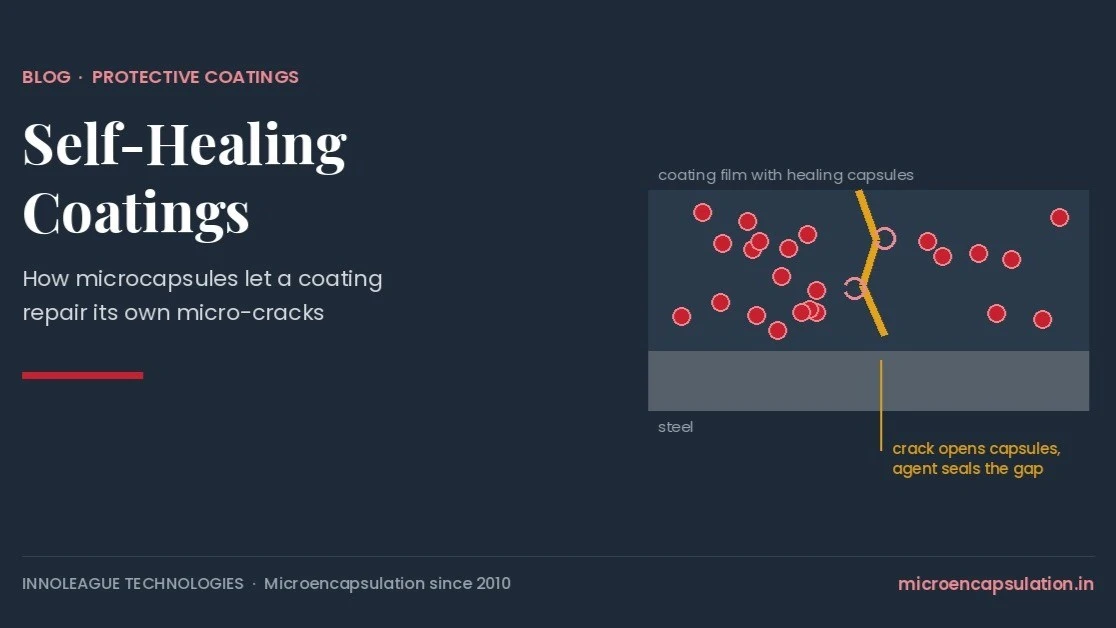
- Self-healing coatings carry tiny capsules of a liquid healing agent. When a crack runs through the paint film, the capsules in its path break and the agent seals the crack.
- Most corrosion under paint starts at hairline cracks that are too small to see, long before rust shows on the surface.
- Whether a capsule works in a real paint depends on its size, the strength of its shell and how well it suits the resin.
Steel structures near the coast, pipelines and plant buildings are painted to last for years. In practice the coating often starts to fail much earlier, and the failure begins where nobody can see it. Hairline cracks open in the paint film with heat, sunlight, vibration and small knocks. Moisture and salt get in through them and reach the steel. By the time rust stains appear, the damage under the film has already spread.
Microencapsulation gives a coating a way to deal with these cracks as they form. Self-healing coatings have moved out of the laboratory and into commercial use, and the capsules are what make it possible.
What is a self-healing coating?
A self-healing coating is a paint or protective coating that can repair small cracks without anyone touching it. In the capsule-based type, microscopic capsules filled with a liquid healing agent are mixed into the paint. A crack that runs through the dry film breaks the capsules it meets. The agent flows into the crack, hardens there and closes the gap.
Why protective coatings fail
A coating protects steel only as long as the film stays unbroken. Once a crack opens, water, oxygen and chlorides have a path to the metal. Corrosion then spreads sideways under the paint, which is why blisters and flaking often show up some distance from the original crack.
Repairs are expensive. The area has to be reached, cleaned back to bare metal and painted again. On a bridge, a jetty or a running plant that can mean scaffolding, traffic diversions or a shutdown.
Across the world the cost adds up quickly. A two-year study by NACE International, released in 2016, estimated the global cost of corrosion at US$2.5 trillion a year, about 3.4 per cent of global GDP. The same study estimated that making better use of existing corrosion control practices could save between 15 and 35 per cent of that amount.
How the capsules repair a crack
The principle was first shown in 2001, when researchers at the University of Illinois published their work in Nature. They placed microcapsules of a healing agent, together with a catalyst, inside a structural polymer. When the material cracked, the capsules broke and the agent was drawn into the crack by capillary action. There it reacted with the catalyst and bonded the two faces of the crack together. In their fracture tests the repaired material recovered as much as 75 per cent of its original strength.
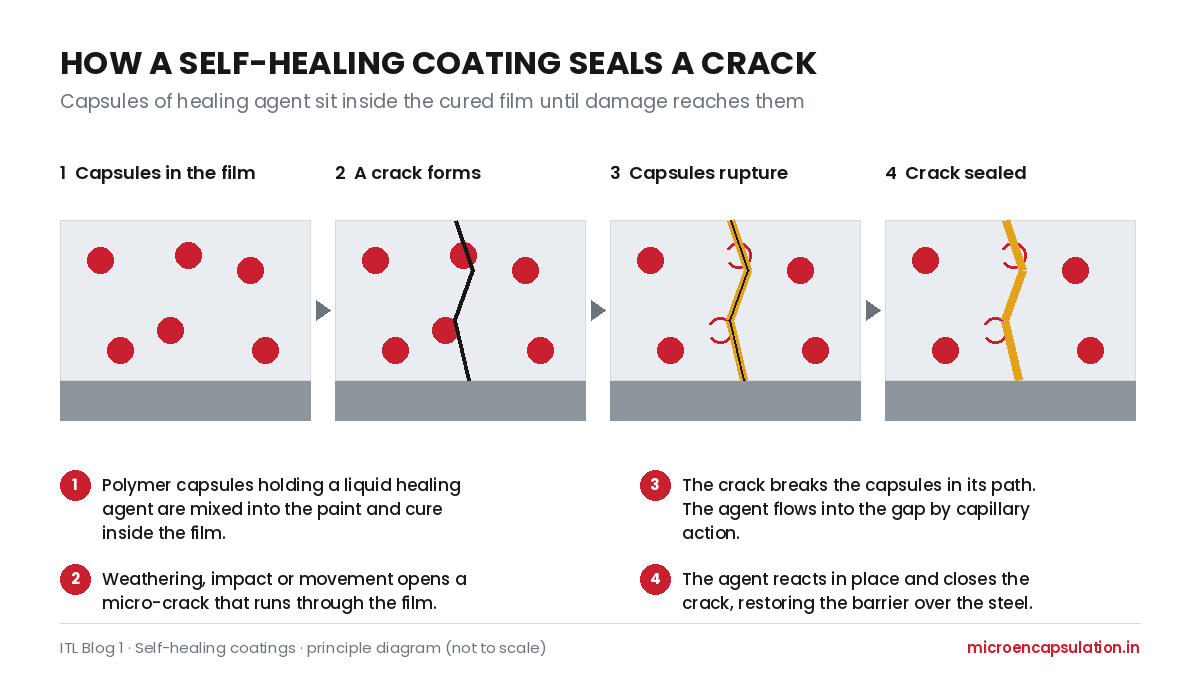
A capsule-based self-healing coating works in the same order.
- Polymer capsules holding a liquid healing agent are mixed into the paint and cure inside the film along with it.
- Weathering, an impact or movement in the structure opens a fine crack through the film.
- The crack breaks the capsules lying in its path, and the agent is drawn into the gap.
- The agent reacts where it sits and closes the crack, so the barrier over the steel is restored.
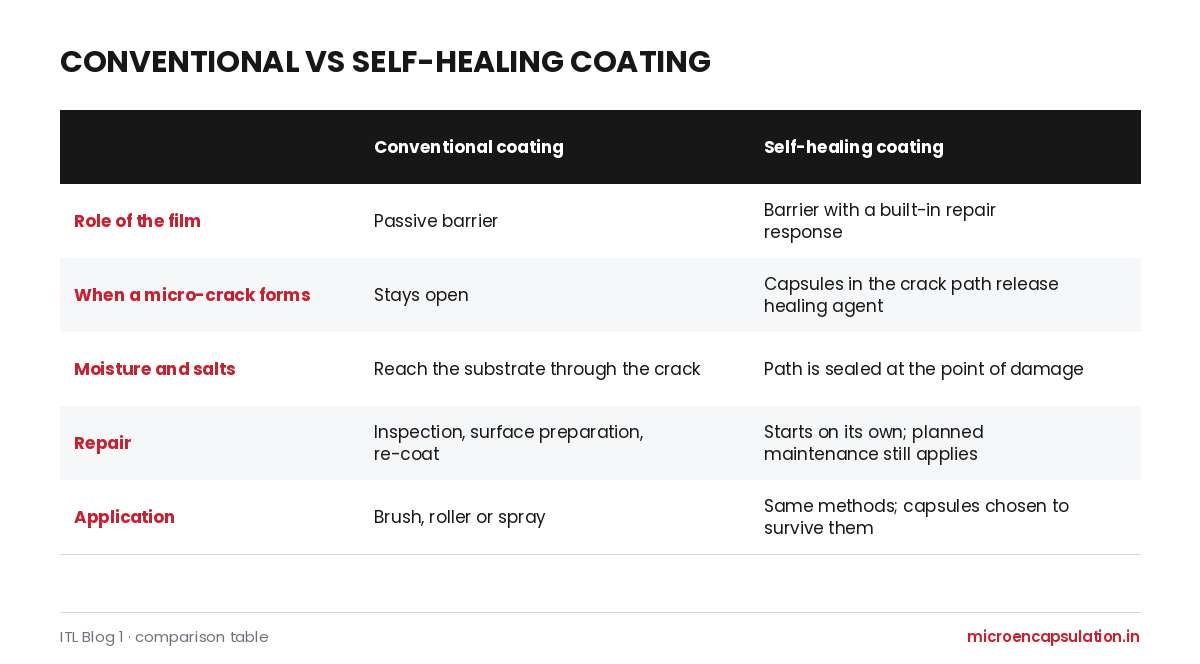
Conventional coating and self-healing coating compared
What a paint formulator should check
Adding capsules to a paint is simple enough in the lab. Making them work in a production paint takes more care. The Illinois team pointed out in 2001 that the shell has to be strong enough to survive processing and still weak enough to break when a crack reaches it. That balance runs through most of the checks below.
- Capsule size and film thickness. The capsules should sit inside the dry film without spoiling the finish, and still be large enough to carry a useful amount of healing agent.
- Shell strength. Capsules have to come through mixing, pumping and airless spraying intact, and then break reliably when a crack arrives.
- Fit with the resin system. They should not affect curing, adhesion or the chemistry of the base coat, whether that is an epoxy, a polyurethane or another system.
- Loading level. Too few capsules and the coating cannot heal. Too many and hardness, flexibility or gloss may suffer. The right level is found in trials for each paint.
- Stability in the can. Capsules need to stay whole and evenly spread through the paint’s shelf life.
For these reasons the capsule should be designed for the coating it will go into. A paint maker usually gets better results by running trials with the capsule supplier than by adding a standard grade off the shelf.
Where self-healing coatings are used
- Industrial protective coatings on steel structures and pipelines, where corrosion under the film is the main way coatings fail
- Architectural coatings for humid or coastal locations, where moisture and salt enter through hairline cracks
- Automotive primer layers for underbody corrosion protection, where stone chips and flexing cause constant small damage
In India, the building of new roads, ports and industrial corridors has created a large demand for protective coatings that can last 15 to 25 years without repainting. Much of this steel stands in coastal or humid air, where hairline cracks do the most harm. Self-healing coatings tackle the problem at the point where it starts.
How self-healing performance is tested
Paint makers usually test the same coating twice, once with capsules and once without, on identical panels.
- Scribe test. A controlled scratch is cut through the film down to the metal. After exposure, delamination and corrosion around the scratch are rated, for example to ISO 4628-8.
- Salt spray. ISO 9227 describes neutral and acidified salt spray tests that reveal pores and defects in coatings. The standard itself warns that the results do not predict service life directly, so outdoor or long-term exposure is still needed.
- Microscope check. Looking at the damaged area under a microscope shows whether the healing agent has filled and closed the crack.
- Basic film properties. Adhesion, hardness, flexibility and appearance are checked to make sure the capsules have not changed what the coating already does well.
Capsule-P SH1000 and SH2000 from Innoleague
Innoleague Technologies has worked on microencapsulation since 2010, and self-healing capsules for paints and coatings are one of the areas we have built up over that time. We hold 8 patents and make capsules at our plants in Rasayani and Bhiwandi in Maharashtra.
Capsule-P SH1000 and SH2000 are our microencapsulated healing agent systems for protective and architectural coatings. We welcome JDA discussions with paint manufacturers and coating formulators who would like to try them in their own systems.
If you are planning a coating for steel in coastal or industrial conditions, we can suggest a Capsule-P grade and a starting dose for side-by-side trials with your present system.
Formulating a protective or architectural coating? Talk to Innoleague Technologies about Capsule-P. microencapsulation.in
Frequently asked questions
What is a self-healing coating?
A self-healing coating has a built-in way to repair small cracks. In capsule-based coatings, tiny capsules of healing agent break when a crack forms and seal it without any outside repair.
Do self-healing capsules change how the paint is applied?
No. They are designed for normal mixing and for application by brush, roller or spray. The shell is chosen so that the capsules survive application and break only at a crack.
Does a self-healing coating replace surface preparation and maintenance?
No. It adds protection on top of a correctly specified and applied coating system, and it reduces the effect of small damage over the life of the coating.
How is a self-healing coating tested?
Usually by comparing coated panels with and without capsules, using a scribe test, salt spray exposure and a microscope check of the damaged area.
Sources
- Self-healing material, University of Illinois (Nature, 15 Feb 2001), ScienceDaily
- NACE study estimates global cost of corrosion at $2.5 trillion annually, Inspectioneering
- ISO 9227:2022 Corrosion tests in artificial atmospheres, Salt spray tests, ISO
- ISO 4628-8 Assessment of delamination and corrosion around a scribe, Standards Council of Canada
- About Innoleague Technologies, microencapsulation.in
- Specialties, microencapsulation.in
- Innoleague Technologies LinkedIn text on self-healing coatings (1 Sep 2026)