


What exporters of encapsulated products need to know
- Since 17th October 2023, EU law treats tiny synthetic polymer particles that do not dissolve or break down as microplastics, and limits how much of them a product sold in the EU may contain.
- Microcapsules with a synthetic polymer shell can fall under this rule. Encapsulated fragrances have until 17th October 2029, and other product groups have their own dates.
- Shells made from natural polymers that are not chemically modified, or from polymers that pass the EU degradation tests, are outside the definition.
Indian makers of detergents, fabric conditioners, cosmetics and agricultural products who sell into Europe now face a question from their buyers. Does the product contain microplastics, and if so, by when will it be reformulated? For many of these products the answer depends on a part the buyer never sees, the shell of the microcapsule that carries the fragrance or active.
This blog explains what the EU restriction covers, the dates that matter for each product group, and what takes a capsule shell outside the rule.
What the EU microplastics restriction covers
Commission Regulation (EU) 2023/2055 was adopted on 25th September 2023 and came into force on 17th October 2023. It adds synthetic polymer microparticles to Annex XVII of REACH, the EU list of restricted chemicals. In everyday terms it is the restriction on intentionally added microplastics.
Under the regulation, a synthetic polymer microparticle is a solid polymer that makes up at least 1 per cent by weight of a particle, or forms a continuous coating on its surface, where the particle measures 5 mm or less in every direction. Fibre-like particles up to 15 mm long also count when their length is more than three times their width. The European Commission sums it up as synthetic polymer particles below 5 mm that are organic, insoluble and resist degradation.
Such particles can no longer be sold on their own. A mixture may not contain them at 0.01 per cent by weight or more where they are added to give the product a property, and many product groups were given extra time to change their formulations.
Why microcapsules come into the picture
A microcapsule is a very small particle with a shell around a core. When the shell is a synthetic polymer and the capsule is well under 5 mm, it can meet the definition above. For the same reason the regulation gives synthetic polymer microparticles used to encapsulate fragrances a transition period of their own.
The rule has exemptions as well. Among them are microplastics used at industrial sites and contained so that they are not released, and microplastics permanently built into a solid matrix during use. Whether an exemption fits a particular product is a question for the formulator’s regulatory team, product by product.
The dates exporters should plan around
The 0.01 per cent limit applies to each product group from its own date.
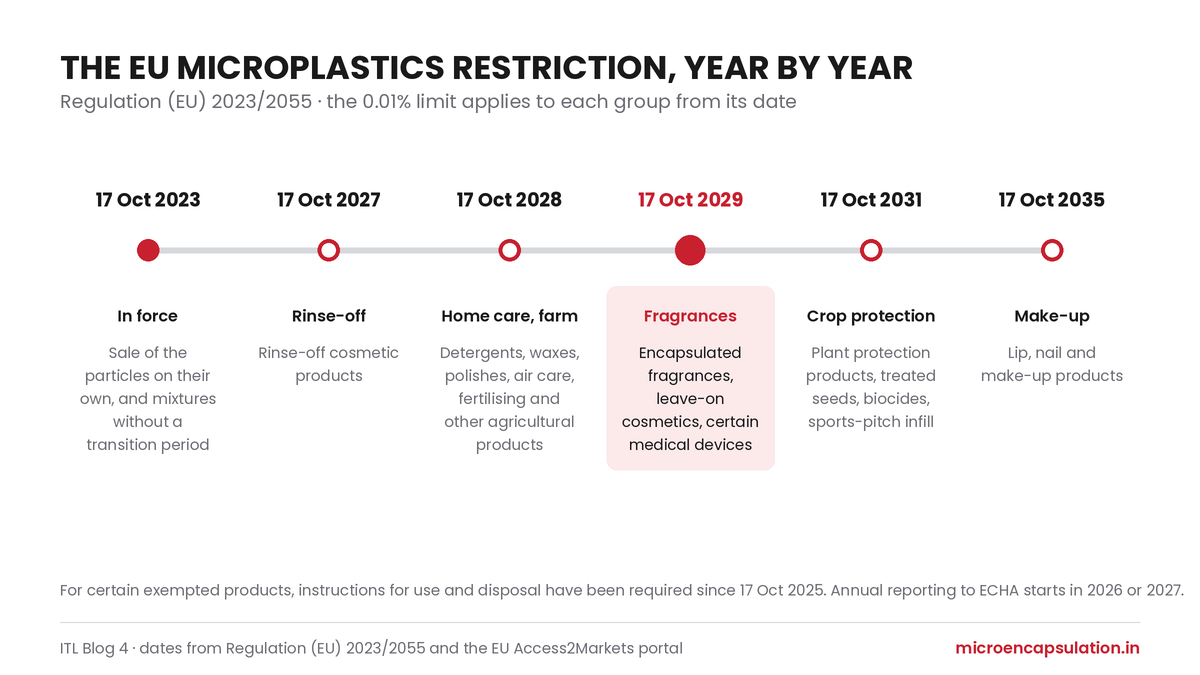
- 17th October 2027. Rinse-off cosmetic products.
- 17th October 2028. Detergents, waxes, polishes and air care products, fertilising products and other agricultural and horticultural products.
- 17th October 2029. Synthetic polymer microparticles used to encapsulate fragrances, leave-on cosmetic products and certain medical devices.
- 17th October 2031. Plant protection products, treated seeds and biocidal products, and granular infill for synthetic sports surfaces.
- 17th October 2035. Lip, nail and make-up products.
Some duties have already started. Since 17th October 2025, suppliers of certain exempted products must give instructions for use and disposal, and annual reporting to the European Chemicals Agency begins in 2026 or 2027, depending on the type of user.
For an exporter of a fragranced detergent or a leave-on cream, this means the capsule inside has a fixed end date in the EU. Choosing a new shell, testing its stability in the product and getting the buyer’s approval all have to happen before that date, and each of these steps takes time.
What takes a capsule shell outside the definition
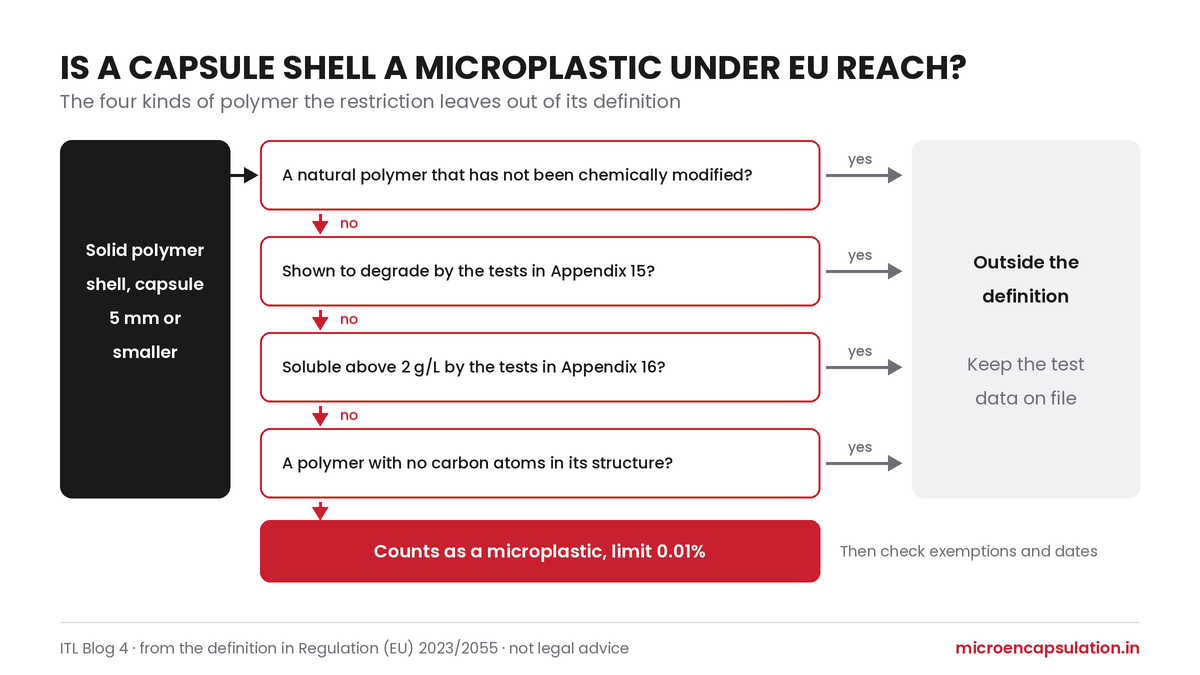
The regulation does not treat every polymer as a microplastic. It leaves four kinds out of the definition.
- Natural polymers that have not been chemically modified.
- Polymers shown to be degradable by the tests set out in Appendix 15 of the restriction.
- Polymers with a solubility above 2 g/L under the tests in Appendix 16.
- Polymers with no carbon atoms in their structure.
Where a company relies on degradability or solubility, the proof sits with that company. Manufacturers, importers and downstream users must be able to show the test results, and must give the identity and function of their polymers when authorities ask for them.
So a biodegradable capsule shell, in the sense that matters for EU trade, is either a natural polymer left unmodified or a polymer that has passed the Appendix 15 tests, with the data on file. Describing a shell as green or bio-based does not settle the question by itself.
A biodegradable shell still has to do its job
A capsule shell has to hold its core through manufacturing and storage, survive the formulation it goes into and release at the right moment, whether that is on friction, with heat or slowly over time. A shell designed to break down in the environment also has to stay stable in a bottle of detergent or a jar of cream for the whole shelf life of the product.
This is why a move to a biodegradable shell is a development project for each product. Stability and release should be tested in the customer’s own base, at the dosage the customer plans to use, well before the product group’s date.
Questions to ask your capsule supplier
- What is the shell made of, and is it a synthetic polymer under the EU definition?
- If the shell is described as degradable or soluble, which Appendix 15 or Appendix 16 test was run, and can we see the report?
- Which product group, and therefore which date, applies to our product in the EU?
- Has the capsule been tested for stability and release in our own formulation?
- What information on use and disposal will come with the capsule?
Working with Innoleague on capsule shells
Innoleague Technologies started in Mumbai in 2010 and holds 8 patents, with production at Rasayani and Bhiwandi. Our customers include paint, textile, FMCG, pesticide and paper companies. Developing biodegradable products is part of our mission, alongside encapsulation solutions and fabric chemicals.
For companies that export to Europe, we can look at your current capsule, the product group it falls under and the shell options for your formulation, and plan trials in your own base so the change is ready before your date.
Exporting to Europe? Talk to Innoleague about capsule shells for the EU microplastics rules at microencapsulation.in
Frequently asked questions
Does the EU microplastics restriction apply to microcapsules?
It applies to capsules whose shell is a solid synthetic polymer and that meet the size conditions in the definition. Shells made from natural polymers that are not chemically modified, or from polymers that pass the EU degradation or solubility tests, are outside the definition.
When do encapsulated fragrances have to comply?
Synthetic polymer microparticles used to encapsulate fragrances have until 17th October 2029. After that date the 0.01 per cent limit applies to them.
Does the restriction apply to products made in India?
It applies to products placed on the EU market, wherever they are made. Indian companies that export to the EU, or supply ingredients to EU brands, need to meet it for those products.
What does a biodegradable shell have to prove?
A polymer counts as degradable only if it passes the tests set out in Appendix 15 of the restriction. The company relying on that must be able to show the test data.
Sources
- EUR-Lex, Commission Regulation (EU) 2023/2055 of 25 September 2023 amending Annex XVII to REACH as regards synthetic polymer microparticles https://eur-lex.europa.eu/eli/reg/2023/2055/oj/eng
- European Commission Access2Markets, Restriction of microplastics in the EU from 17 October 2023 https://trade.ec.europa.eu/access-to-markets/en/news/restriction-microplastics-eu-17-october-2023
- SGS SafeGuardS 126/23, EU regulates microplastics under REACH https://www.sgs.com/en/news/2023/10/safeguards-12623-eu-regulates-microplastics-under-reach
- About Innoleague Technologies, microencapsulation.in https://www.microencapsulation.in/about/