


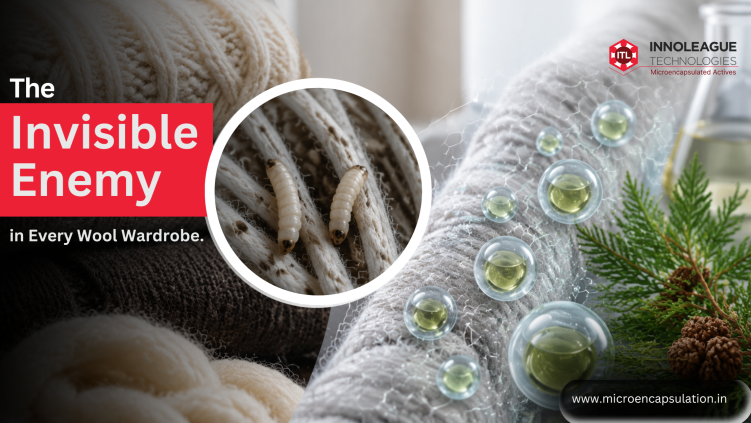
Every year, the global wool industry loses hundreds of millions of dollars to an enemy so small it is invisible to the naked eye the clothes moth.
Tineola bisselliella, the common clothes moth, does not eat your finest cashmere itself. Its larvae do. Silently, invisibly, over weeks and months in storage reducing irreplaceable wool fibres to dust.
This is not a problem limited to household wardrobes. It is a multi-billion dollar challenge spanning the entire wool supply chain from premium Merino spinners in Australia to artisan carpet weavers in Kashmir, from luxury fashion houses in Milan to heritage blanket mills in the UK. A single infestation in a commercial store can write off an entire season’s inventory.
The wool industry’s conventional answer has been moth-proofing chemistry primarily permethrin and other synthetic pyrethroids applied at fabric finishing. These treatments have broadly worked. But the industry is at a clear inflection point.

Consumer expectations around chemical residues are rising sharply. Regulatory frameworks in Europe and major export markets are tightening. Certification bodies are raising the bar on what is acceptable in a premium natural fibre product. And brands that lead on sustainability credentials are finding it increasingly difficult to justify synthetic insecticide finishes regardless of the product they are protecting.
At Innoleague Technologies India Pvt Ltd, we have spent years thinking about this problem differently. Our answer is not to formulate a better synthetic insecticide. It is to deploy the natural world’s own moth-repelling compounds and to deliver them to the fabric in a way that makes them last.

That delivery system is microencapsulation. And over the coming weeks, we want to walk you through exactly what we are doing, why it matters, and who we are working with to bring it to the global wool industry.
#MothProofing #WoolIndustry #Microencapsulation #TextileSustainability #InnoleagueTechnologies #NaturalTextiles #WoolInnovation