


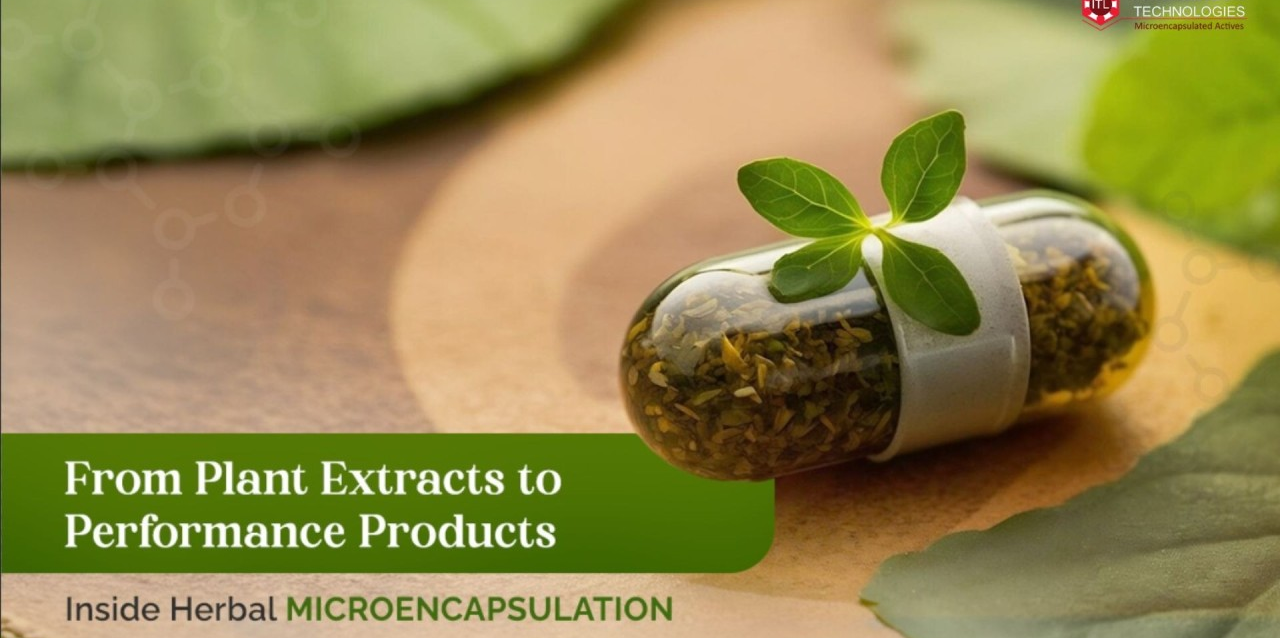
Sustainable manufacturing has been a recent trend in the textile industry, with increasing focus on plant-based products. Be it the paradigm shift towards natural dyeing or antibacterial finishes, plant-based extracts are ruling the market again. Bioactive components present in plant saps, agricultural waste, and even leaves and flower extracts have attracted attention for various functional finishes. Neem oil, eucalyptus oil, and cedarwood oil have been conventionally used as insect repellents and antimicrobial agents. The natural products although face a major disadvantage i.e. of durability. In order to overcome the concerns of product efficiency and finish durability, these extracts need to be applied on the textile materials with higher adhesion capacity.
Microencapsulation technology protects the functionality and effectiveness of the bioactive compounds and renders high finish durability. The natural oils are often volatile, sensitive to pressure and temperature, and susceptible to degradation over time. Microencapsulation offers to enclose the bioactive extracts into a protective polymer layer which protects and stabilises active ingredients and enables controlled release.
Plant derived oils constitute of active compounds which render these oils their functional properties. However, these compounds are volatile and lose their effectiveness if not preserved properly. This further restricts the application of such plant-based formulations. Innoleague Technologies transform herbal extract into reliable performance-based products.
Microencapsulation surrounds the tiny droplets of active ingredients in a protective polymeric layer, forming micron size particles called microcapsules. The microcapsules are prepared by either spray drying, coacervation, or centrifugal extrusion. Amongst these, spray drying is the most commercialised process for microcapsule production due to its economic viability. A dispersion of herbal oil and polymer is sprayed into a hot chamber.
The shell material solidifies onto the herbal extracts after the evaporation of solvent to form the microcapsules. After the microcapsules are prepared, they are applied either as a functional finish on a textile substrate, or incorporated into the hygiene and preservation products as an active ingredient.
The major advantage of microencapsulation technology for herbal extracts is the controlled release i.e., instead of releasing all the herbal extract at once, microcapsules gradually release small amounts of the active compounds over time. This keeps the bioactive compounds effective for a longer duration without repeated application.
The microencapsulated herbal extracts have been utilised by multiple industries, although prominently by textile and packaging sector. These are being incorporated into moth repllent sachets for wardrobe and storage areas. Microencapsulated neem and cedarwood oil are also applied in paper and packaging to deter pests during storage and transportation.
In textiles, these are applied on to the fabrics and garments as finishing agents to improve comfort and preserve the fabric performance. Household and homecare products are also incorporated with microcapsules to render freshness for prolonged periods.
Microencapsulation is a twin forked approach to render sustainable products, as it reduce the dependence on chemical-based pest control products, and enhances the durability and efficiency of plant-based products.
Innoleague Technologies pioneers in research and product development focussing on mainstreaming the traditionally used botanical ingredients with novel microencapsulation technology aiming to cater to various industries with next-gen products.